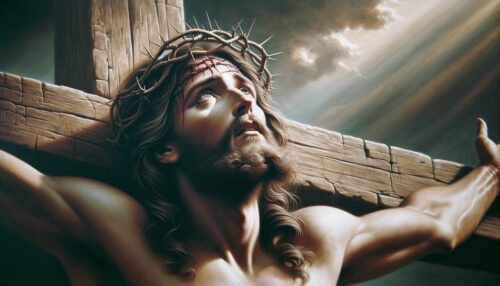
This is a summary of the sermon preached on Sunday July 19, 2026.
- Date: Sunday July 19, 2026
- Venue: A Sunday service at Returnees' Retreat at Karuizawa Retreat Center
- Title: "God who loves and saves the world"
- Scripture: John 3:1-16 1
Introduction
News of wars continues without end.
The cost of everyday necessities keeps rising.
The threat of epidemics and infectious diseases has not disappeared.
Many of us also carry anxieties about the future—concerns that linger quietly in our hearts.
In times like these, it is vital that we
Among today's passage, John 3:16 is undoubtedly one of the most well-known verses in all of Scripture.
Many have called it the clearest and most concise summary of the Bible's central message.
Today, as we focus on this verse, let us consider
The Kingdom of God
In John 3:1, we are introduced to a man named Nicodemus.
He was a Pharisee and a member of the Jewish ruling council.
Under the cover of night, he came to Jesus to speak with Him.
Surprisingly, however, Jesus did not respond directly to Nicodemus' opening remarks.
Instead, He immediately began speaking about something that seemed completely unrelated—the kingdom of God (John 3:2–3).
It appears that Jesus knew what Nicodemus truly wanted to ask before he even voiced the question.
Seeing into his heart, Jesus addressed the issue that mattered most.
For the Jewish people, the "kingdom of God" referred to
Many Jews believed that faithful obedience to the Law of Moses would qualify them to enter that kingdom.
Yet beneath that confidence lay an important question:
I believe many people quietly wrestled with that uncertainty (cf. Luke 17:20).
So when Jesus began speaking about the kingdom of God, Nicodemus must have listened intently.
He wanted, more than anything else, to understand what Jesus was saying.
But there was a problem.
Despite all of his learning and religious devotion, Nicodemus could not understand Jesus' words at all (John 3:4).
The New Birth from God
Jesus then said to Nicodemus,
Very truly I tell you, no one can see the kingdom of God unless they are born again. (John 3:3, NIV)
A few verses later, He added,
Very truly I tell you, no one can enter the kingdom of God unless they are born of water and the Spirit. (John 3:5, NIV)
When we compare these two statements, it becomes clear that
This new birth is not something we accomplish by our own efforts; it is God's work in us.
Likewise, being born of water and the Spirit points to the cleansing and renewing work of the Holy Spirit.
In other words, both expressions describe the same divine act:
Therefore, the message Jesus was communicating to Nicodemus is unmistakable:
Entrance into God's kingdom is not achieved merely through religious knowledge, sincere devotion, or careful observance of the Law.
It requires a supernatural work of God's grace—a new birth that only He can give.
Faith in Jesus Christ
This raises an important question:
Jesus gives the answer in John 3:14–15.
He points Nicodemus back to an event recorded in the Old Testament, in Numbers 21:4–9.
There, after the Israelites sinned against God, venomous snakes came among them, and many people died.
In His mercy, however, God instructed Moses to make a bronze snake and lift it up on a pole.
Whoever looked at the bronze snake in faith was spared from death and lived.
Jesus then declares:
Just as Moses lifted up the snake in the wilderness, so the Son of Man must be lifted up, that everyone who believes may have eternal life in him. (John 3:14–15, NIV)
Just as the bronze snake was lifted up on a pole, so
And just as those who looked to the bronze snake in faith were saved from physical death,
This is the very same truth Jesus proclaims in the next verse, John 3:16:
whoever believes in Him shall not perish but have eternal life. (John 3:16, NIV)
Throughout the Bible, and especially in the Gospel of John,
Putting these truths together, we see the full picture.
Therefore,
Salvation is not earned by human effort, religious achievement, or moral performance.
Conclusion
When Jesus spoke these words, the Jewish people generally believed that faithful obedience to the Law was the way to enter the kingdom of God.
Yet Jesus declared something entirely different.
He taught that
For Nicodemus, this was a completely new idea—something he had never heard in all his years of studying the Scriptures.
From his perspective, it is understandable that he struggled to grasp what Jesus was saying.
But
The answer is simple:
Scripture teaches that sin is not limited to outward actions such as murder, theft, or deceit.
It also includes
If we have committed such sins even once, we stand guilty before a holy God.
The Bible declares that
the wages of sin is death (Romans 6:23, NIV).
And those who remain under the sentence of death cannot enter the kingdom of God.
But praise be to God—that is not the end of the story.
God was not willing to leave us in that hopeless condition.
Why?
As Jesus declares in John 3:16,
For God so loved the world that he gave his one and only Son, that whoever believes in him shall not perish but have eternal life. (John 3:16, NIV)
Because of that immeasurable love, God gave His one and only Son to save us from the destruction that our sins deserved.
Jesus willingly bore the penalty of our sin—death itself—when He died on the cross in our place.
As a result,
The cross is, above all else, the greatest revelation of God's love.
The world, however, measures people very differently.
It constantly demands results.
It tells us that our worth depends on our achievements, our accomplishments, and our performance.
Whether we are considered successful is often determined not by ourselves, but by our schools, our workplaces, and the opinions of those around us.
As a result, we naturally become preoccupied with what others think.
We work harder and harder in hopes of proving that we are valuable.
If you find yourself carrying an undefined anxiety about the future, perhaps the deepest source of that fear is this question:
The world around us never stops changing, and we cannot know whether we will always be able to achieve the same, unchanging level of success.
That uncertainty often becomes the source of our worry and fear.
The Bible offers us an entirely different foundation.
There was no other way to rescue us from the judgment our sins deserved.
God does not love you because you have accomplished something remarkable.
He does not love you because you are useful to Him.
He does not love you because of what you have done.
That is why
Because of that love, He could not simply watch you perish.
Instead, Jesus Christ gave His life on the cross in your place.
Such is the depth of God's love for you.
Therefore,
As Christians, we do not strive to gain approval, to earn acceptance, or to become worthy of love.
Rather,
That is the life of the one who has believed in Jesus Christ and has been born again by God through the Holy Spirit.
May we, then, refuse to be tossed about by the ever-changing circumstances of this world.
Instead,
Bibliography and Notes
- Burge, Gary M. John. The NIV Application Commentary. Grand Rapids, Mich.: Zondervan, 2000.
- Carson, D. A. The Gospel according to John. Reprint edition. The Pillar New Testament Commentary. Leicester, England; Grand Rapids, Mich.: Wm. B. Eerdmans Publishing Co., 1990.
- Keener, Craig S. The Gospel of John: A Commentary. Peabody, Mass.: Hendrickson, 2003.
- Michaels, J Ramsey. The Gospel of John. The New International Commentary on the New Testament. Grand Rapids, Mich.: Eerdmans, 2010.